How pubmed-stream works
This guide explains the repository: what each part does, how data moves from NCBI to your disk and into a knowledge graph, and how the pieces are tested. It combines diagrams, tables, code and figures drawn from a real example study. For day-to-day usage, the README is the reference.
Contents
- At a glance
- Repository map
- Talking to NCBI
- Downloading full text
- Evidence neighborhoods
- Knowledge graphs
- AI assistants, local models and Obsidian
- The example study in figures
- Data model
- Testing
- Extending pubmed-stream
1. At a glance
pubmed-stream does three jobs. Each one builds on the one before it, and all three connect to AI assistants, local models and Obsidian (section 7).
| Job | Command | Python | NCBI services | Writes |
|---|---|---|---|---|
| Download full-text articles for a search | pubmed-stream download QUERY |
search_and_download() |
PMC ESearch, PMC EFetch | publications/<query>/PMC*.json |
| Map the evidence around one article | pubmed-stream neighborhood PMID |
get_neighborhood() |
PubMed ELink, EFetch, EPost, ESearch | publications/neighborhood_<PMID>/neighborhood.json |
| Build a study's knowledge graph | pubmed-stream kg TOPIC -q ... -s ... |
create_kg() |
All of the above, plus PubMed EFetch for MeSH terms | kg_<topic>/, an Obsidian vault |
flowchart LR
    U(["Researcher"]) -->|"topic, searches, key articles"| PS["pubmed-stream<br/>CLI or Python"]
    PS <-->|"E-utilities over HTTPS"| NCBI[("NCBI<br/>PubMed and PMC")]
    PS -->|"JSON per article"| PUB["publications/"]
    PS -->|"Markdown notes"| KG["kg_topic/"]
    KG -->|"Open folder as vault"| OBS["Obsidian<br/>graph view, Bases, search"]
    PUB -->|"read when building"| PS
    AI(["AI assistant"]) <-->|"MCP tools"| PS
    PS <-->|"review"| OL["Ollama<br/>local model"]
The only runtime dependency is requests. Everything else, including the XML parsing, the YAML frontmatter and the Markdown rendering, uses the Python standard library.
2. Repository map
pubmed-stream/
├── pubmed_stream/
│   ├── __init__.py        public API: everything importable from pubmed_stream
│   ├── __main__.py        python -m pubmed_stream
│   ├── cli.py             argparse front end: init, search, download, list, neighborhood, kg, review, open, mcp
│   ├── corpus.py          compact records of downloaded articles, most-cited works
│   ├── mcp_server.py      MCP server: pubmed-stream's tools for AI assistants
│   ├── review.py          summaries by a local model through Ollama, with checks
│   ├── obsidian.py        opening knowledge graphs in Obsidian
│   ├── assistants.py      init: instructions and MCP settings for Claude Code, Codex, Gemini CLI
│   ├── data/AGENTS.md     the instructions for AI assistants
│   ├── settings.py        the user's settings file, with the NCBI API key, and a folder's own
│   ├── downloader.py      E-utilities client, PMC search and download, JATS parsing
│   ├── neighborhood.py    similar, citing and cited articles of a PubMed article
│   ├── vault.py           Obsidian notes: graph model, merging, rendering, safe rewrites
│   ├── impact.py          how a paper spread: citers of many papers, counts, citing sentences and their kinds
│   └── kg.py              studies: topic, searches and seeds, refresh
├── plugins/             the Claude Code and Codex plugin: manifests, the MCP server through uvx, AGENTS.md as a skill
├── tests/                 155 offline tests; NCBI and Ollama are faked with canned responses
├── tutorials/             seven notebooks, the AI assistant tutorial, guides, kg_study.py, keyword lists, tools
├── studies/               research done with pubmed-stream, one folder per study with its frozen data, scripts and write-up
├── docs/                  this guide and its figures
├── pyproject.toml         package metadata, dependencies and the tutorials extra
├── CHANGELOG.md           changes in each version
├── CITATION.cff           citation metadata for GitHub's Cite this repository
└── LICENSE                MIT
| Module | Lines | Responsibility | Main public functions |
|---|---|---|---|
downloader.py |
1229 | HTTP client with rate limiting and retries; PMC search and summaries; full-text download, with a progress callback; metadata, reference and text extraction from JATS XML | search_and_download, search_pmc, esearch_pmc, esummary_pmc, efetch_pmc, extract_metadata_from_pmc_xml |
neighborhood.py |
474 | ELink relations, PubMed records with flags and MeSH terms, flag counts beyond the cap | get_neighborhood, save_neighborhood, download_neighborhood |
vault.py |
1118 | Merges every source into one graph of papers, concepts and collections, then writes notes without losing user edits, with Obsidian property types and a Bases table | build_vault, topic_vault_dir |
kg.py |
284 | The study layer: runs searches and seeds, records them, refreshes them, reports each step | create_kg, load_study, record_study |
impact.py |
383 | How a paper spread: the citers of many papers at once, counts by year and flag through PubMed's history server, the sentences in which full texts or Semantic Scholar cite it and their kind, and the annotation of a knowledge graph; used by tutorial 8 | citers_of, count_by_year, count_flags, citation_contexts, classify, semantic_scholar_contexts, annotate |
corpus.py |
128 | Reads downloaded articles back as compact records, each once; counts the works they cite | list_articles, most_cited |
review.py |
351 | Summaries by a local model through Ollama's API, at temperature 0, with number and citation checks | review, save_to_vault |
mcp_server.py |
496 | The Model Context Protocol over standard input and output, with nine tools and progress notifications; library output kept off the protocol | serve |
obsidian.py, assistants.py |
256 | Opening graphs through Obsidian URIs; writing instructions and MCP settings into a research folder | open_vault, init_folder |
settings.py |
62 | The user's settings file in the home folder, where init saves the NCBI API key, and a folder's own |
saved_api_key, set_setting |
cli.py |
951 | Parses arguments and maps them onto the functions above; sets exit codes; writes UTF-8 to pipes | main |
The modules form a strict stack. Each one imports only from the modules below it, so the download layer never knows about vaults, and the vault never calls the CLI; settings.py, which imports nothing, sits under them all. Nothing in the package imports impact.py; tutorial 8 does:
flowchart TB
    M["mcp_server.py<br/>tools for AI assistants"] --> C
    M --> KG
    M --> V
    M --> N
    M --> D
    CLI["cli.py<br/>init / search / download / list /<br/>neighborhood / kg / review / open / mcp"] --> KG["kg.py<br/>create_kg, studies"]
    CLI --> M
    CLI --> RV["review.py<br/>Ollama summaries"]
    RV --> C
    RV --> V
    CLI --> C["corpus.py<br/>list_articles, most_cited"]
    CLI --> V
    CLI --> N
    CLI --> D
    KG --> V["vault.py<br/>build_vault"]
    KG --> N["neighborhood.py<br/>get_neighborhood"]
    KG --> D["downloader.py<br/>search_and_download"]
    I["impact.py<br/>citers_of, citation_contexts"] --> V
    I --> D
    V --> N
    V --> D
    N --> D
    D --> R(["requests"])
3. Talking to NCBI
Every request goes through one of two paths in downloader.py. Both share a thread-safe RateLimiter, so concurrent downloads never exceed NCBI's limits.
| Endpoint | Database | Used for | Called by |
|---|---|---|---|
esearch.fcgi |
pmc |
Find PMC articles for a search, up to max_results |
esearch_pmc |
esummary.fcgi |
pmc |
Titles, journals, years and identifiers, to preview a search without downloading | esummary_pmc, search_pmc |
efetch.fcgi |
pmc |
Full-text JATS XML, one article per request | efetch_pmc |
elink.fcgi |
pubmed |
Similar, citing and cited articles, in one call with cmd=neighbor_score |
get_neighborhood |
efetch.fcgi |
pubmed |
PubMed records: titles, publication types, grants, MeSH terms; 200 PMIDs per request | get_neighborhood, build_vault |
epost.fcgi + esearch.fcgi |
pubmed |
Count reviews, retractions, NIH funding and PMC coverage across links beyond the cap | get_neighborhood |
Ollama /api/generate |
local | One summary per abstract, at temperature 0 with a length cap; not NCBI, and only when you run review |
review |
| Setting | Value | Why |
|---|---|---|
| Requests per second | 10 with NCBI_API_KEY, 3 without |
NCBI's published limits; detected automatically |
| Retries | 3 attempts, waiting 2 s, then 4 s | Rides out rate-limit replies (HTTP 429) and network blips |
| Timeout | 60 s per request | Large full-text articles |
| Download threads | 5 by default, --workers to change |
Full text is fetched one article per request |
| API key in logs | Always redacted | Error messages from requests contain the full URL |
The shared request helper is short enough to read in full. This is its core:
for attempt in range(retries):
    try:
        rate_limiter.wait()                      # shared across threads
        resp = session.get(url, params=params, timeout=REQUEST_TIMEOUT)
        resp.raise_for_status()
        return resp
    except requests.RequestException as e:
        error = _redact_api_key(e)               # never log the API key
        logger.warning("%s attempt %d/%d failed: %s", endpoint, attempt + 1, retries, error)
        if attempt < retries - 1:
            time.sleep(RETRY_DELAY * (attempt + 1))
raise requests.RequestException(f"{endpoint} failed: {error}")
4. Downloading full text
sequenceDiagram
    participant U as You
    participant D as search_and_download
    participant N as NCBI E-utilities
    participant F as publications/query/
    U->>D: query, max_results
    D->>N: ESearch db=pmc
    N-->>D: PMC IDs and total count
    D->>F: query.json, the original search
    par up to 5 threads
        D->>N: EFetch db=pmc, one article
        N-->>D: JATS XML
        D->>D: no body? unavailable, publisher withholds XML
        D->>D: extract metadata, references, text
        D->>F: PMCxxxx.json
    end
    D-->>U: DownloadStats
Re-running a search skips files that already exist, so a refresh only downloads new articles. Each article becomes one JSON file:
{
  "pmcid": "PMC13279599",
  "source": "PMC",
  "download_date": "2026-10-18T13:20:45",
  "metadata": {
    "pmid": "42060019",
    "doi": "10.1007/s40520-026-03403-6",
    "title": "Association between gut microbiota and sarcopenia in older adults: ...",
    "journal": "Aging Clinical and Experimental Research",
    "year": "2026",
    "authors": ["Ramezani Kashal Fatemeh", "..."],
    "abstract": "Introduction Investigating gut microbiota has emerged ...",
    "keywords": ["Sarcopenia", "Gut microbiota", "Aging", "Muscle metabolism"],
    "references": [
      {"pmid": "32033882", "title": "Asian Working Group for Sarcopenia: 2019 Consensus Update ...", "year": "2020"}
    ]
  },
  "text": "Introduction\nInvestigating gut microbiota ..."
}
| Extracted from the JATS XML | Field | Notes |
|---|---|---|
| Article IDs | pmid, pmcid, doi |
From article-id elements |
| Title, journal, dates | title, journal, year, month, day |
Electronic publication date preferred |
| Authors | authors |
"Surname Given names" |
| Abstract and keywords | abstract, keywords |
All abstract sections joined |
| Reference list | references |
Cited works with a PMID or DOI; these become citation links in the knowledge graph |
| Body text | text |
Title, abstract and body, one paragraph per line; omitted with --exclude-text |
5. Evidence neighborhoods
A neighborhood is the programmatic counterpart of NLM's Linked Discoveries page for one article. It costs two requests for up to 200 articles, plus five more for each relation that max_per_relation cuts short.
sequenceDiagram
    participant U as You
    participant G as get_neighborhood
    participant N as NCBI E-utilities
    U->>G: PMID, max_per_relation
    G->>N: ELink pubmed, cmd=neighbor_score
    N-->>G: similar with scores, cited by, references
    G->>N: EFetch pubmed, seed and neighbors, 200 per request
    N-->>G: titles, publication types, grants, MeSH terms
    opt a relation was cut by max_per_relation
        G->>N: EPost all its PMIDs
        G->>N: ESearch x4, reviews, retracted, NIH, in PMC
        N-->>G: flag counts over every linked article
    end
G-->>U: Neighborhood| Flag on each article | How it is decided |
|---|---|
is_review |
Publication type is Review, Systematic Review or Scoping Review |
is_retracted |
Publication type Retracted Publication, or a RetractionIn notice |
nih_funded |
An N.I.H. support publication type, or a grant whose agency names NIH |
pmcid |
The article has a PMC ID, so its full text may be downloadable |
mesh_terms |
MeSH descriptors, each with its ID and a major-topic flag |
6. Knowledge graphs
6.1 A study from start to finish
create_kg is the study layer. It runs what is new, or everything with refresh=True, then hands the folders to build_vault:
sequenceDiagram
    participant U as You
    participant K as create_kg
    participant S as study.json
    participant D as search_and_download
    participant H as get_neighborhood
    participant V as build_vault
    U->>K: topic, queries, seeds, refresh
    K->>S: read earlier searches and seeds
    loop each search to run
        K->>D: query
        D-->>K: download folder, or an error to report
    end
    loop each seed to run
        K->>H: PMID
        H-->>K: neighborhood folder, or an error to report
    end
    K->>S: save every search and seed
    K->>V: new folders
    V-->>K: VaultStats
    K-->>U: KGResult with errors listed
A failed search or seed never stops the study. It is listed in KGResult.errors, kept in study.json so a refresh retries it, and the graph is built from everything else.
6.2 How notes are built
flowchart TB
    A["Sources<br/>remembered + new folders"] --> B["Load articles<br/>PMC*.json"]
    B --> C["Load neighborhoods<br/>neighborhood.json"]
    C --> D["Resolve reference lists<br/>PMID, else DOI, to papers"]
    D --> E{"Paper lacks<br/>MeSH terms?"}
    E -->|"yes, and online"| F["EFetch PubMed<br/>200 per request, cached"]
    E -->|"no, or offline"| G["Render notes"]
    F --> G
    G --> H["papers/"]
    G --> I["concepts/"]
    G --> J["collections/"]
    G --> K["PubMed Stream.md"]
Papers from different sources are merged into one record, so a paper found by two searches and one neighborhood still has one note.
| Rule | Behaviour |
|---|---|
| Identity | A paper is matched by PMID, then PMC ID, then DOI. Its note is named PMID<id>, or by PMC ID when there is no PMID |
| First known value wins | Full-text metadata loads first, so PMC titles and abstracts win over PubMed summaries |
| Flags | Review, retracted and NIH-funded are OR-ed across sources |
| Full text | A paper becomes full text when any source downloaded it; otherwise it is a stub |
| Notes | Only papers with a known title, or with full text, get a note; others stay as unresolved links |
| Concepts | Every MeSH heading becomes a concept note, except check tags such as Humans, Male or Aged |
| Citations | Reference-list entries with a PMID, plus neighborhood cites and cited-by links. DOI-only references are listed but not linked |
6.3 Safe rebuilds
Users write in these notes, so a rebuild must never destroy their work. Each note has a generated block between two markers, and the tool owns a fixed list of frontmatter keys:
flowchart TB
    S["Render the note"] --> X{"File exists?"}
    X -->|"no"| W["Write frontmatter, block<br/>and an empty Notes heading"]
    X -->|"yes"| M["Merge frontmatter:<br/>replace owned keys, keep the user's,<br/>union tags and aliases"]
    M --> R["Replace only the text between<br/>the pubmed-stream markers"]
    R --> Q{"Content changed?"}
    Q -->|"no"| U["Leave the file untouched"]
Q -->|"yes"| W2["Write the file"]| Part of a note | Owned by | On rebuild |
|---|---|---|
Owned frontmatter keys, such as title, pmid, mesh and status |
pubmed-stream | Replaced |
tags and aliases |
Both | The tool's pubmed/... tags are replaced; the user's entries are kept |
| Any other frontmatter key | The user | Kept as written |
Text between %% pubmed-stream:start %% and %% pubmed-stream:end %% |
pubmed-stream | Replaced |
Everything else, such as the ## Notes section |
The user | Kept as written |
6.4 On disk
publications/                                 downloads, shared by every study
├── gut_microbiota_Title_AND_frailty_Title_Abstract/
│   ├── query.json                            the original search
│   └── PMC13279599.json ...
└── neighborhood_31319564/
    └── neighborhood.json
kg_gut_microbiome_frailty/                    one study = one Obsidian vault
├── PubMed Stream.md                          home note
├── papers/PMID42060019.md ...                one note per paper
├── concepts/Sarcopenia.md ...                one note per MeSH heading
├── collections/Search - ... .md              one note per search or neighborhood
├── reviews/<question> (date).md ...         summaries by a local model, from 'review --vault'
├── Papers.base                              a Bases table of the papers, first build only
├── .obsidian/graph.json                      graph-view colour groups, first build only
├── .obsidian/types.json                      property types, added for missing keys only
└── .pubmed-stream/
    ├── study.json                            topic, searches, seeds
    ├── sources.json                          download folders the graph is built from
    └── pubmed_records.json                   cached PubMed records with MeSH terms
7. AI assistants, local models and Obsidian
The three jobs above are also reachable from the tools researchers work in. None of these adds a dependency: they use the standard library, requests, and programs the researcher installs separately.
| Connection | Module | Talks to | How |
|---|---|---|---|
| AI assistants call pubmed-stream's tools | mcp_server.py |
Claude Code, Codex and other MCP clients | JSON-RPC over standard input and output |
| A research folder is set up for them | assistants.py |
Claude Code, Codex, Gemini CLI | Instruction and settings files |
| A local model summarizes abstracts | review.py |
Ollama | HTTP to 127.0.0.1:11434 |
| A graph opens in Obsidian | obsidian.py |
Obsidian | The obsidian:// URI scheme |
7.1 The MCP server
pubmed-stream mcp implements the Model Context Protocol's tool features directly: initialize, ping, tools/list and tools/call, one JSON object per line. It answers the protocol versions from 2024-11-05 to 2025-11-25. Messages are handled one at a time, so an assistant that calls tools in parallel still sends NCBI one request at a time.
sequenceDiagram
    participant A as AI assistant
    participant M as pubmed-stream mcp
    participant L as pubmed-stream library
    participant N as NCBI
    A->>M: initialize
    M-->>A: tools capability and instructions
    A->>M: tools/list
    M-->>A: nine tools with JSON schemas
    A->>M: tools/call search_pmc
    M->>L: search_pmc(query)
    L->>N: ESearch, ESummary
    N-->>L: count, titles
    Note over M,L: progress printed by the library is captured,<br/>so standard output carries only the protocol
    L-->>M: SearchResult
M-->>A: compact text result| Tool | Read-only | Wraps |
|---|---|---|
search_pmc |
yes | search_pmc, and count_pubmed for the PubMed count beside PMC's |
download |
no | search_and_download |
fetch_abstracts |
no | fetch_abstracts |
list_articles |
yes | list_articles, filtered by IDs |
most_cited |
yes | most_cited |
read_article |
yes | The text field of one download, or only its paragraphs that contain a term |
neighborhood |
no | get_neighborhood and save_neighborhood |
export_citations |
no | export_citations, written to a file |
build_knowledge_graph |
no | create_kg |
Each tool is marked read-only or not, so clients can run read-only tools without asking; Codex does. Problems a user can fix, such as a missing folder or NCBI being unreachable, come back as tool results with isError set, so the assistant reads and explains them; only unknown tools and methods are protocol errors. Paths are relative to the folder the server starts in, which assistants set to the project folder, or to --root.
The instructions the server returns from initialize are the assistant's only guidance where neither AGENTS.md nor the plugin's skill is loaded, as with a server registered by hand, so they name every tool and the order to use them in, and say to prefer pubmed-stream's tools to other PubMed tools the assistant may have; a test keeps them naming every tool. When a tools/call carries a progress token in _meta, download, fetch_abstracts and build_knowledge_graph send notifications/progress while they run, written to the protocol stream between the request and its response: the library's search_and_download, fetch_abstracts and create_kg take a progress callback, called with (done, total, message), and the server turns it into notifications, dropping any that would not increase progress, as the protocol requires. create_kg counts one step per search and seed and one for the build, and reports a download's own progress as a fraction of its step.
7.2 Setting up a folder
pubmed-stream init writes what each assistant reads when it starts in a folder:
| File | Read by | Contents |
|---|---|---|
AGENTS.md |
Codex, and through imports the others | The instructions, shipped in the package as pubmed_stream/data/AGENTS.md |
CLAUDE.md, GEMINI.md |
Claude Code, Gemini CLI | @AGENTS.md, which imports the instructions. Claude Code 2.1.277 and later reads AGENTS.md by itself, and never twice, so CLAUDE.md serves older versions |
.mcp.json |
Claude Code | The MCP server, started with the Python that has pubmed-stream installed |
.codex/config.toml |
Codex | The same server, with start-up and call timeouts |
.claude/settings.json |
Claude Code | The folder's model, with --claude-model |
.pubmed-stream.json |
pubmed-stream review |
The folder's local model, with --review-model |
~/.pubmed-stream.json |
The command line and the MCP server, in every folder | The user's NCBI API key, with --ncbi-api-key, or typed when init asks for it in a terminal while none is configured; a skipped question is recorded as an empty key, so init asks once. The MCP server saves the Claude Code plugin's key here too, when none is saved, after the first tool call in which NCBI accepted it. NCBI_API_KEY in the environment takes precedence |
Files that exist are kept: the import line and the server entries are added to them if missing, and AGENTS.md is rewritten only with --force. There is no Codex model option: Codex 0.163 reads a folder's MCP servers but ignores its model, as tested, so Codex's model is chosen with codex -m or /model.
The plugin in plugins/pubmed-stream is the other way in, for Claude Code and Codex in every folder: a manifest for each (.claude-plugin/plugin.json, .codex-plugin/plugin.json), each naming the server command uvx --from "pubmed-stream==<version>" pubmed-stream mcp, so the plugin runs the PyPI release of its own version whatever is installed; and the skill skills/literature-search/SKILL.md, which is AGENTS.md under a note about the plugin. The Claude Code manifest carries the server inline, asks for the NCBI API key at install (userConfig) and passes it to the server as PUBMED_STREAM_NCBI_API_KEY, a name of its own so that it never overrides the user's NCBI_API_KEY. The Codex manifest points at .codex-plugin/mcp.json, which has no such entry, so that server uses the key saved with init --ncbi-api-key; that file also gives the server 60 s to start and 600 s per call, since Codex allows 10 and 60 by default, the first start downloads pubmed-stream, and a large download or a knowledge graph takes minutes (Codex 0.163 reads both fields from a plugin's file, and from a path other than the root, as tested). The plugin has no root .mcp.json: Claude Code would load it beside the inline entry, and Anthropic's plugin directory checks that file against its own schema, which has no Codex timeouts. NCBI answers every request made with an invalid key with 400 API key invalid, so a key is checked once per process (check_api_key): init refuses to save one NCBI rejects, and a configured key NCBI rejects is dropped with a warning, so requests continue without it at 3 a second; the server also tells the assistant so, once, at the end of the next tool result. After a download that a key would have shortened by 10 s or more, the command line and the download tool say by how much (api_key_hint), and init ends with the key's status (api_key_status). The marketplaces at the repository root, .claude-plugin/marketplace.json and .agents/plugins/marketplace.json, let the assistants install it from GitHub. The two ways meet in plugin_installed: init reads the assistants' settings (~/.claude/settings.json lists enabled plugins, and a plugin added on the claude.ai account, which Claude Code syncs into ~/.claude/plugins/synced/ with no settings entry unless the user turns it off, counts too; Codex enables one with a [plugins."pubmed-stream@<marketplace>"] table in config.toml), and where the plugin is enabled it writes no server for that assistant, and removes one it wrote earlier, with the action plugin; otherwise the assistant would list every tool twice. The Claude Code manifest's key option has an empty default, because Cowork ignores a server that references an option without one and never asks for values. Gemini CLI has no plugin, so its settings always get the server.
7.3 Local reviews
A 1-billion-parameter model cannot design searches or call tools reliably, so review keeps it to reading, and keeps everything it cannot be trusted with in code:
flowchart TB
    R["Downloaded articles<br/>chosen by ID"] --> S["One prompt per abstract"]
    S --> O["Ollama<br/>temperature 0, capped length"]
    O --> T["Summary"]
    T --> ID["PMID attached by pubmed-stream"]
    T --> NUM{"Every number<br/>in the abstract?"}
    NUM -->|no| FLAG["Flagged under the summary"]
    ID --> ANS["Optional answer from all summaries"]
    ANS --> CIT{"Every cited PMID<br/>among those read?"}
CIT -->|no| FLAG2["Listed in bold"]| Choice | Why |
|---|---|
| One abstract per request | Fits the model's working memory, and a summary cannot mix two papers |
| Temperature 0 | The same articles give the same summaries |
num_predict 300, or 500 for the answer, and a repeat penalty |
At temperature 0 a small model can repeat itself until its context is full; a capped reply is marked as cut |
num_ctx 8192, with a warning when a prompt fills it |
ollama run uses 4,096 tokens and drops the overflow silently |
| Numbers checked as digits and as words below 100 | Abstracts write "Seventy-two patients"; summaries write "72" |
7.4 Obsidian
build_vault writes three files for Obsidian, each without overwriting the user's version:
| File | Written | Purpose |
|---|---|---|
.obsidian/graph.json |
Once, if missing | Colour groups for the graph view |
.obsidian/types.json |
Missing keys only | Property types: year a number, retracted a checkbox, authors, mesh and keywords lists |
Papers.base |
Once, if missing | A Bases table of papers/, with views for all papers, full text, reviews, retracted papers and #to-read |
The home note embeds Papers.base and lists the notes in reviews/. open_vault opens the home note with obsidian://open?path=..., but only for folders listed as vaults in Obsidian's own settings file, since Obsidian ignores the URI for folders it does not know.
8. The example study in figures
The figures below are drawn from the notes of the study in tutorials/kg_study.py: two searches on the gut microbiome with frailty and with sarcopenia, plus the neighborhood of a 2019 review, PMID 31319564. docs/figures/make_figures.py regenerates them from any knowledge graph.
| Part of the graph | Count |
|---|---|
| Papers with full text, from the two searches | 42 |
| Stub papers, from the seed's neighborhood | 85 |
| MeSH concept notes | 309 |
| Collections | 3 |
| Citation links between papers in the graph | 115 |
| Similar-article links between papers in the graph | 30 |
| Notes in total, with the home note | 440 |
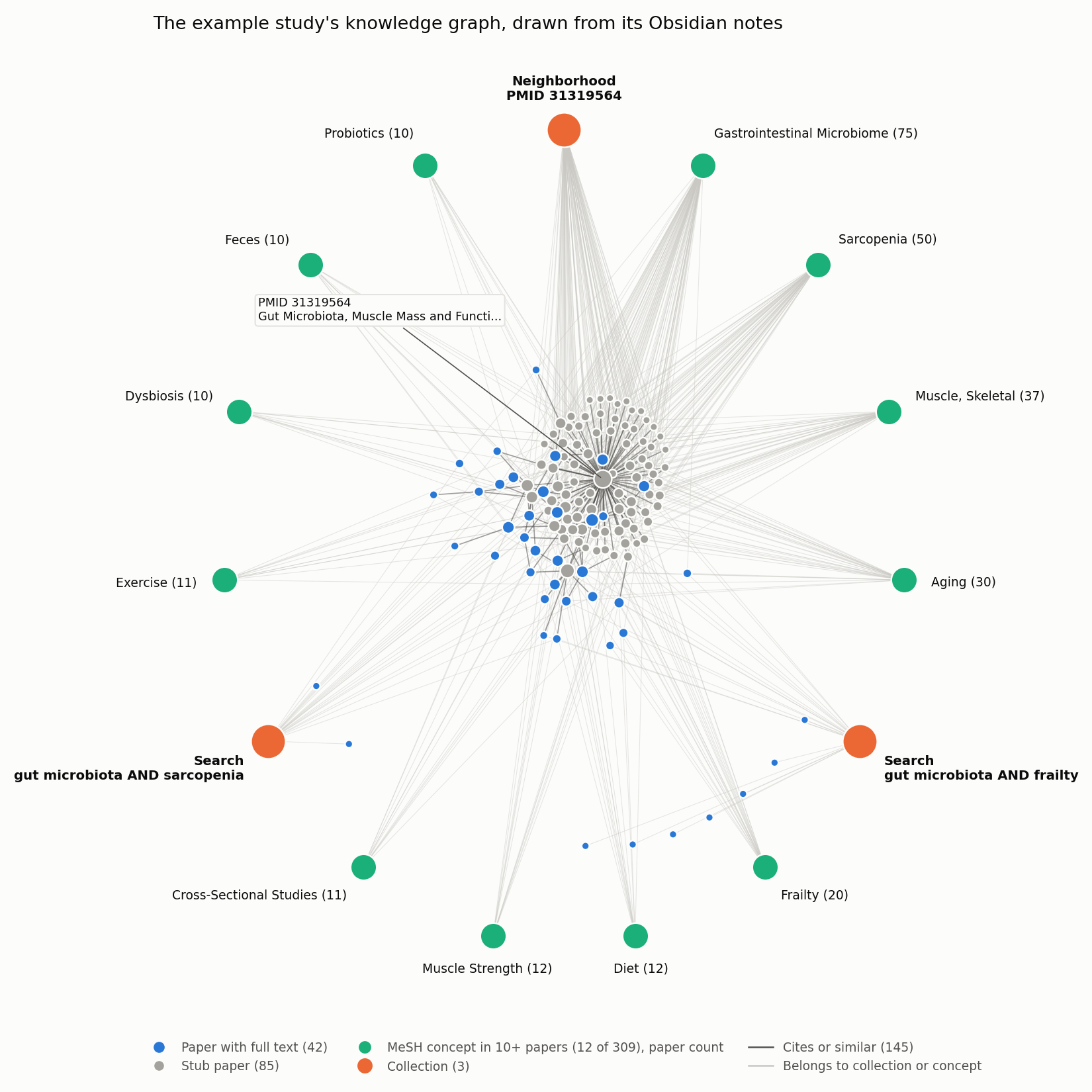
The knowledge graph as a network. The seed review sits at the center, ringed by its neighborhood of stub papers. Papers from the two searches attach to it through citations. Twelve MeSH concepts, those linked by ten or more papers, sit on the outer ring with the three collections. Papers with no citation inside the graph stay close to the search that found them. Obsidian's graph view shows the same structure, interactively.
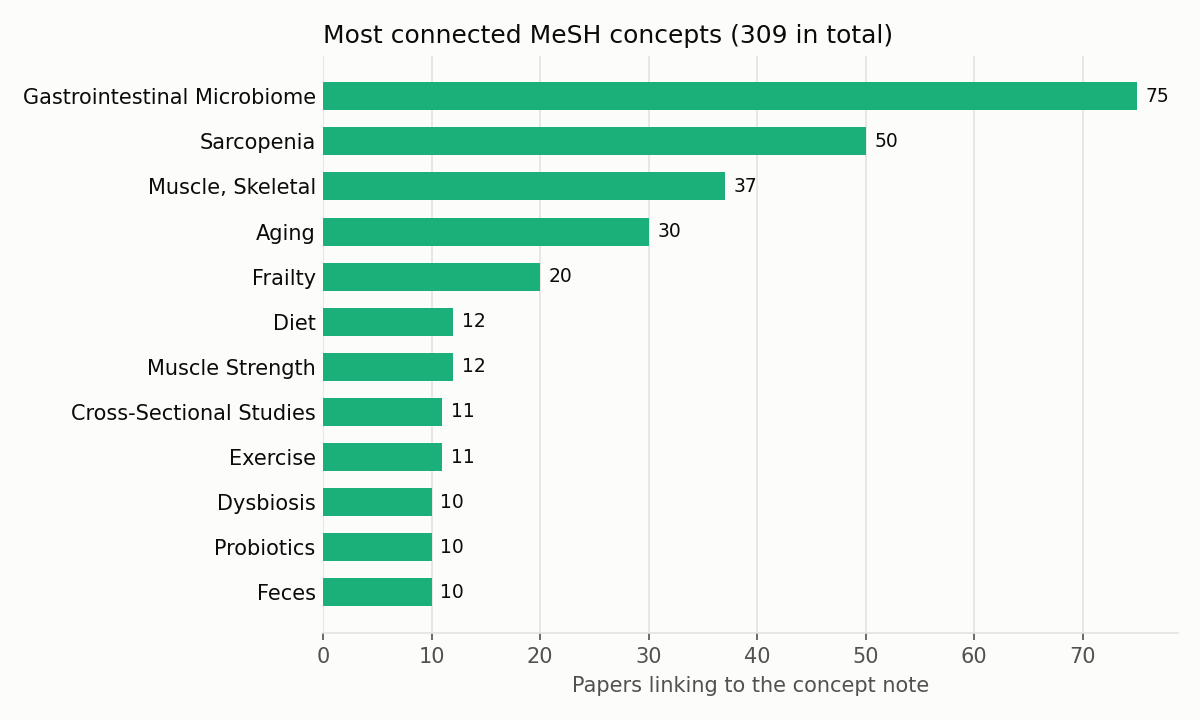
The concepts that tie the study together. Gastrointestinal Microbiome links 75 papers and Sarcopenia 50. These hubs are where papers from different searches meet.
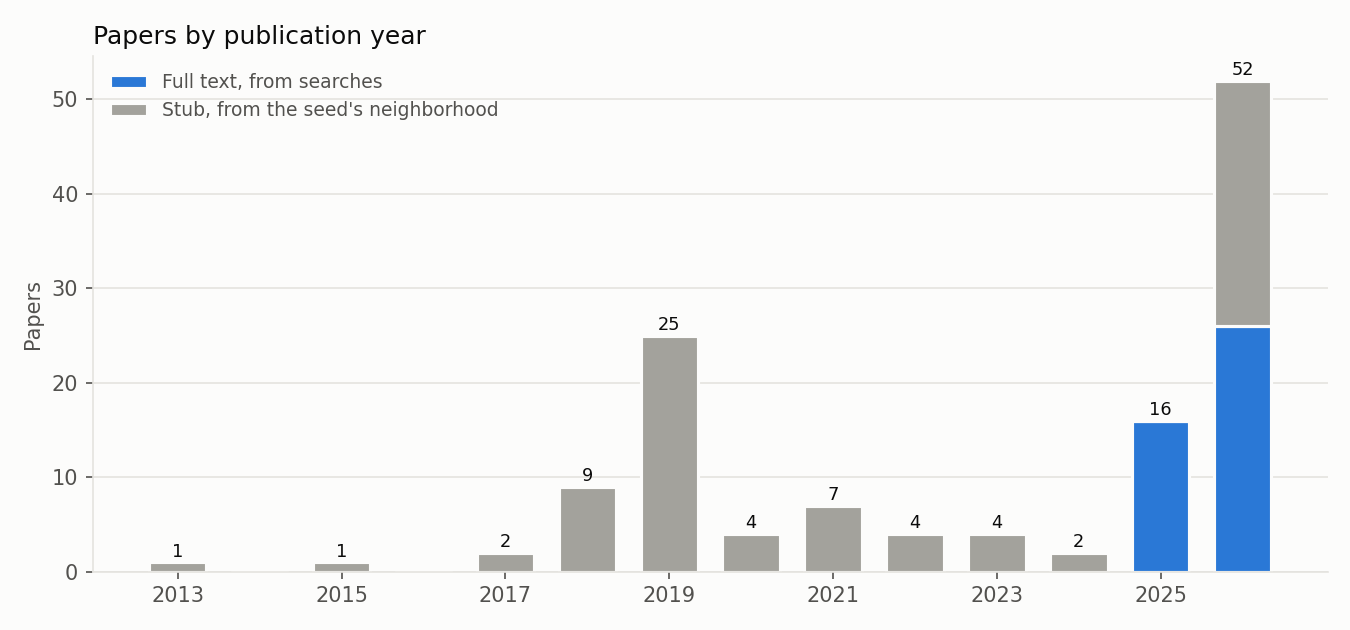
Searches and neighborhoods complement each other. The full-text papers from the searches are all from 2025 and 2026, because PMC returns the newest matches first. The seed's neighborhood adds the older literature, peaking in 2019, the seed's own year, through the papers it cites and those PubMed rates as similar.
| Year | 2013 | 2015 | 2017 | 2018 | 2019 | 2020 | 2021 | 2022 | 2023 | 2024 | 2025 | 2026 |
|---|---|---|---|---|---|---|---|---|---|---|---|---|
| Full text | 0 | 0 | 0 | 0 | 0 | 0 | 0 | 0 | 0 | 0 | 16 | 26 |
| Stub | 1 | 1 | 2 | 9 | 25 | 4 | 7 | 4 | 4 | 2 | 0 | 26 |
9. Data model
classDiagram
    class DownloadStats {
        keyword
        total_found
        requested
        successful
        skipped
        unavailable
        errors
        output_dir
    }
    class RelatedArticle {
        pmid
        pmcid
        doi
        title
        year
        pub_types
        is_review
        is_retracted
        nih_funded
        score
        mesh_terms
    }
    class Neighborhood {
        pmid
        seed
        similar
        cited_by
        references
        totals
        flag_counts
        articles()
    }
    class VaultStats {
        vault_dir
        sources
        papers
        full_text
        stubs
        concepts
        collections
        created
        updated
        unchanged
    }
    class KGResult {
        topic
        kg_dir
        queries
        seeds
        downloads
        neighborhoods
        vault
        errors
    }
    Neighborhood "1" o-- "*" RelatedArticle : seed, similar, cited_by, references
    KGResult "1" o-- "*" DownloadStats : downloads
    KGResult "1" o-- "*" Neighborhood : neighborhoods
KGResult "1" o-- "0..1" VaultStats : vault| Class | Returned by | Meaning |
|---|---|---|
DownloadStats |
search_and_download, download_neighborhood |
One download run: found, requested, saved, skipped, unavailable |
RelatedArticle |
inside Neighborhood |
One PubMed article with its flags and MeSH terms |
Neighborhood |
get_neighborhood |
A seed and its three relations, with uncapped totals and flag counts |
VaultStats |
build_vault |
One build of the notes: counts of papers, concepts and changed files |
KGResult |
create_kg |
One run of a study: what ran, what failed, and the build |
10. Testing
All tests run offline in about two seconds. NCBI is replaced by a fake HTTP adapter that answers by URL, so tests exercise the real request and parsing code:
session = make_session(routes={
    "esearch.fcgi?db=pmc": search_json(["1"]),     # a PMC search finding one article
    "efetch.fcgi?db=pmc": full_xml,                # its JATS full text
    "elink.fcgi": elink_json,                      # a neighborhood
    "efetch.fcgi?db=pubmed": pubmed_xml,           # PubMed records with MeSH terms
})
result = create_kg("gut microbiome study", queries=["gut microbiome"], seeds=["100"],
                   session=session, rate_limit=0, offline=True)
| Test file | Tests | Covers |
|---|---|---|
test_parsing.py |
13 | JATS metadata, dates, references and text extraction |
test_download.py |
12 | Search, download, skipping, unavailable articles, API key redaction, query files, folder names |
test_integrations.py |
15 | MCP protocol and tools, keeping output off the protocol, Ollama reviews and their checks, vault notes, Obsidian property types and the papers base, opening vaults, init |
test_search_list.py |
14 | Search previews, summaries and retries, listing and deduplication, most-cited works, CLI output, quiet mode, UTF-8 pipes |
test_neighborhood.py |
24 | Relations, flags, MeSH terms, capped counts, saving, CLI |
test_vault.py |
25 | Citation links, stubs, concepts, escaping, safe rebuilds, sources, MeSH cache, naming |
test_kg.py |
14 | Studies, refresh, failure reporting, validation, CLI |
11. Extending pubmed-stream
| To add | Change | Keep in mind |
|---|---|---|
| A new field from the full text | extract_metadata_from_pmc_xml in downloader.py |
Old downloads lack it; read it with a fallback |
| A new flag on neighbors | _parse_pubmed_article, and _FLAG_FILTERS for uncapped counts, in neighborhood.py |
Add the matching PubMed search filter |
| A new link type in the graph | _Graph loading and _render_paper in vault.py |
Links must point at note names, such as PMID123 |
| A new note type, such as authors | A renderer and its owned keys in vault.py |
Add its keys to an owned-keys tuple, or rebuilds will treat them as the user's |
| A Logseq or other output format | A second renderer over the same _Graph |
The graph model is format-independent; only rendering is Obsidian-specific |
| A new study option | create_kg in kg.py, then the kg parser in cli.py |
Record anything a refresh must repeat in study.json |
| A release | __version__ in __init__.py (pyproject.toml reads it), CITATION.cff, and in plugins/pubmed-stream the two plugin.json, the release the server runs in .codex-plugin/mcp.json and in .claude-plugin/plugin.json, and the skill's note; tests/test_plugin.py names any left behind |
Publish to PyPI before pushing the bump: the plugin fetches the release of its own version through uvx, so until it exists on PyPI, plugin users' server fails to start |
| A new MCP tool | TOOLS and a handler in mcp_server.py, its place in the server's INSTRUCTIONS, and its name beside the matching command in data/AGENTS.md, copied into the plugin's SKILL.md |
The tests check that the instructions and AGENTS.md name every tool and that the skill is AGENTS.md under its note; a handler that runs long takes the progress callback |